
WinCrown · Welcome bonus200 free spins on selected slots
Reviews (9,827)
4.9Rating
 Best casinos available in AustraliaUpdated 7 November 2026
WinCrown · Welcome bonus200 free spins on selected slots
Reviews (9,827)
4.9Rating
To play real money casino online from Australia you open an account at an offshore site, deposit in AUD, pick a game and, if there is anything left, withdraw it after an identity check. None of those sites holds an Australian licence, so the order in which you do things matters more than which pokie you choose. Below is the whole route for a first session, with the cost of each decision worked out in dollars.
Most guides start with a list of casinos. We start with the sequence, because the sequence is the same wherever you end up and it is where the money is saved or lost.
People usually do steps five and six first and discover the rest when something goes wrong. Doing them in this order costs you about twenty minutes and tells you, before any serious money is on the site, whether the operator is worth it. Each step is unpacked below.

The short version: the law targets the companies, not the player. Under the Interactive Gambling Act 2001 it is illegal to provide online casino games, pokies included, to customers in Australia. Online sports betting and lotteries can be licensed here; online casino games cannot. So every site where you can spin a pokie for dollars is run from overseas.
The Australian Communications and Media Authority polices this. It investigates sites, publishes its findings and asks internet providers to block services that breach the Act. Playing is not an offence for you, but the trade-off is plain: if an offshore operator will not pay, no Australian body can force it to. Your recourse is the operator's own complaints process and whatever licensing authority it answers to.
That is why the checks in this guide lean so heavily on evidence you gather yourself. We keep the detail, with sources, in our legal status file.
You do not need to be an investigator. You need to answer four questions, and if you cannot answer one of them from the site itself, that is your answer.
Who is the operator?Scroll to the footer and the terms. There should be a company name, a registration address and a licence claim that names an authority. A brand name, a logo and the word “licensed” are not the same thing. Where the licensing body offers a public lookup, use it and compare the domain listed there with the one in your address bar. Our operator check walks through it.
What are the withdrawal rules?Find the minimum withdrawal, the maximum per week or month, the stated pending time and any rule that a deposit must be wagered a number of times before it can be withdrawn. That last one is common offshore and is explained in the three-times deposit rule. If the limits page is vague, ask live chat and save the reply.
Are the games genuine?Open any pokie in demo mode and tap the info or help icon. A real release shows the studio name, the rules and an RTP figure. Well-known studios publish their game lists, so a title you cannot find on the studio's own site is suspect. Our provider pages show what a genuine help screen looks like for each major studio.
Does the marketing make sense?“No wagering”, “instant withdrawals” and “guaranteed” are claims, and claims need terms behind them. If the promotions page says one thing and the bonus terms say another, the terms win every time. Spotting affiliate language lists the phrases that should slow you down.
Every casino game has a built-in margin, and every game is played at a different speed. Multiply the two and you get an hourly price. The table below uses round, illustrative figures to show the method. The real edge of any game is on its help screen or in its published rules, and the pace is yours to control.
Two things jump out. Pokies are not the most expensive game because of the edge alone; they are expensive because they are fast. And live tables are cheap per hour at the same stake mostly because a dealer can only spin a wheel so often. The single-zero roulette edge of 2.7 per cent is fixed by the wheel: one green pocket out of thirty-seven. A double-zero wheel nearly doubles it, so check which wheel you are on.
Turbo and autoplay settings change the right-hand column more than any choice of game. Double the speed and you double the hourly cost without changing your odds on a single spin. If your budget for the night is A$40, a pokie at A$1 a spin on turbo is priced to finish it in well under two hours on average, and volatility can make that twenty minutes. More on pacing in volatility and bankroll.
Crash games deserve their own note. They feel like skill because you choose when to cash out, but the margin is built into the distribution of crash points and no exit strategy removes it. Crash game maths shows why a cautious target and a greedy one carry the same expected cost per dollar.
The registration form looks like a formality. It is the document your withdrawal will be checked against. Enter your legal name as it appears on your licence or passport, your current residential address as it appears on a recent bill or bank statement, and your real date of birth. Abbreviations and nicknames cause rejections weeks later.
Choose AUD if the form offers it. Some sites fix the account currency permanently at sign-up, and an account in euros or US dollars means paying an exchange spread on every deposit and every withdrawal. If AUD is not in the list, treat every advertised amount as approximate; our AUD deposit notes show how these claims get muddled.
Then go straight to the verification section of your profile and upload documents before depositing. Typically you will be asked for photo ID, proof of address and, once you have paid in, proof that the payment method is yours. Doing it at a zero balance means that any back-and-forth with support happens while you have nothing to lose. It also means your first withdrawal is not sitting in a queue behind a document check. Details are in verification before cashout.
Use a unique password and switch on two-step login if the site has it. Casino accounts are a target because they hold both money and identity documents.
Size first. The right first deposit is the smallest amount that lets you play for the time you intended and still clears the minimum withdrawal. If the minimum cashout is higher than your deposit, you need to finish ahead just to get anything back, which is a quiet way of locking small players in. Look that number up before you choose an amount.
Then the method. Open the cashier and look at what is actually offered to your account, then open the withdrawal tab and look again. A method that appears on both lists is worth more than one that only goes in.
Whichever you choose, keep the receipt. The page on cards and bank transfers covers what a clean payment record looks like.
The deposit screen will probably offer a welcome bonus, often pre-selected. Taking it changes the rules of your session. Your money and the bonus are usually locked together until a wagering requirement is met, there is a cap on the size of each bet, some games count for less or not at all, and there is a deadline.
Here is a way to price it, using made-up numbers. Deposit A$100, receive a A$100 bonus, wagering 35 times the bonus. That is A$3,500 in bets. On a pokie returning 96 per cent, the expected cost of A$3,500 in bets is A$140. You were given A$100 and it costs about A$140 on average to unlock it. The same bonus at 20 times costs about A$80 to unlock and is worth having. The multiple is the whole story, and what it multiplies matters just as much: “35x deposit plus bonus” in this example would be A$7,000 in bets.
Check also which balance is spent first. At some sites your cash goes first and the bonus is only touched once your own money is gone, which means the bonus rarely helps. Bonus balance order explains how to tell, and how to read a bonus gives the full checklist.
If the sums do not work, decline. A cash-only balance can be withdrawn whenever you like, subject to the site's deposit turnover rule, and nobody can void a win because one spin was over a limit you did not know about.
A demo pokie from a reputable studio runs the same maths as the paid version. The reels are not looser in practice mode. What changes is you. With play credits people bet big, chase features and ignore the balance; with their own dollars, the same people should bet a fraction of that and often do not adjust.
Use demo mode for what it is good at: learning how a feature triggers, seeing how often a game pays small wins, and finding the help screen with the RTP and the maximum win. Twenty minutes of demo spins on a high-volatility game is a cheap way to see how long it can go without paying. RTP basics explains how to read those screens.
What demo cannot show is the casino. Deposit speed, bet limits under a bonus, support quality and withdrawals only reveal themselves with money on the line, which is the reason for keeping the first deposit small.
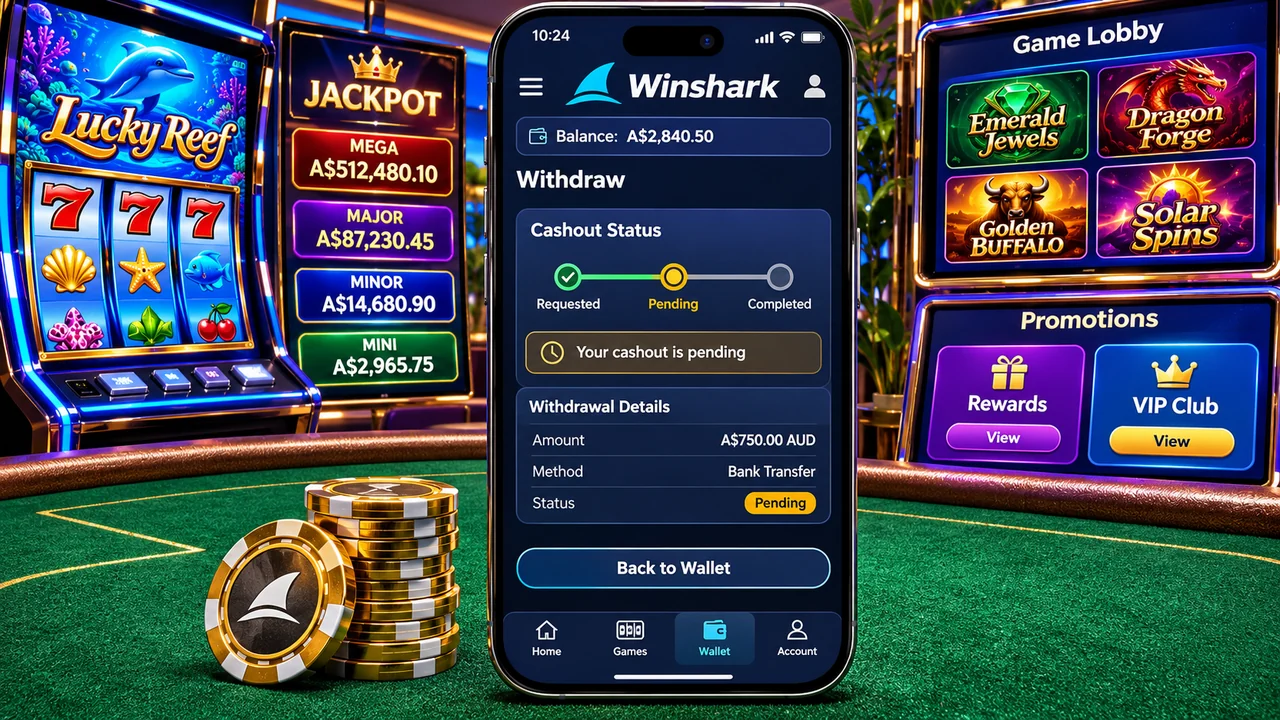
At the end of the first session, withdraw whatever remains, provided it is over the minimum. Treat it as a test you are running on the operator. Note the time you pressed the button. Note the status it shows. Note every email.
You are measuring three things. How long the request sits as pending before anyone looks at it. Whether new document requests appear only after you ask for money. And whether the amount that lands matches the amount requested, or whether a fee was taken on the way. Compare all three with what the terms said; pending times explains what the usual stages mean.
While a withdrawal is pending, many sites show a button to cancel it and return the funds to your balance. That button exists because it works. If you have decided to cash out, close the tab. And read the ceiling in withdrawal limits so you know how a bigger win would be paid: in one piece, or in instalments over months.
If the test fails, you have lost very little and learned what you needed. Keep the screenshots; the dispute record shows how to lay them out if you take the matter further.
The withdrawal-to-deposit ratio in the third point is worth a second look, because it is easy to miss. Suppose, purely as an example, a site takes deposits from A$10 but pays out only from A$100. A casual player who deposits A$20 has to multiply the balance five times before a single dollar can leave. Most will not, and the leftover A$30 or A$60 gets played back down to zero. Nothing in that arrangement breaks the site's own terms. It simply means small balances almost never leave, and you can see it coming by reading two numbers side by side before you pay in.
Pressure tactics deserve the same cold reading. A timer that says an offer ends in nine minutes will usually show nine minutes again tomorrow. A message from a “personal manager” after a losing night is a retention script. Neither tells you anything about the games; both tell you how the operator sees its customers.
One flag on its own might be sloppiness. Two or three together are a pattern, and there is always another site.
Before you log in, settle three numbers: the budget for the session, the stake per spin or hand, and the time you will stop. A workable rule of thumb is a stake no bigger than one per cent of the session budget on high-volatility pokies, so that a cold run does not end the night in ten minutes. On A$50, that is 50 cents a spin.
Add one more number if you like: the balance at which you will withdraw. Deciding it in advance is easier than deciding it mid-feature. Then log the result afterwards, win or lose. A month of honest entries shows you the real price of the hobby better than memory will; tracking a session has a simple layout.
Online casino games are for adults aged 18 and over. Play with money you can afford to lose and stop when the budget is spent.
The Interactive Gambling Act 2001 makes it an offence to offer online casino games to people in Australia; it does not penalise the player. Because the sites are offshore, Australian regulators cannot recover your money in a dispute. ACMA publishes the services it has investigated.
Per hour, slow games with a low house edge cost least: blackjack played with basic strategy and single-zero roulette at a live table. Pokies cost more mainly because of their speed. Lowering the stake and switching off turbo cuts the cost of any game.
Only after multiplying out the wagering. Work out the total bets required, estimate the expected cost at the game's RTP and compare it with the bonus amount. If the cost is higher than the bonus, or the terms cap your withdrawal, play with cash.
Small enough that losing it does not matter, and large enough that a modest remaining balance clears the minimum withdrawal. Check the minimum cashout before choosing the amount. The aim of the first deposit is to test the site, not to win big.
Genuine studio games use the same maths in both modes. What differs between casinos is the RTP version the operator has chosen, so check the help screen of the real-money game you open. Demo mode cannot tell you anything about withdrawals.
Operators are required by their licences and payment partners to confirm who they are paying and that the payment method belongs to the account holder. It is standard everywhere. Upload documents before depositing so the check is done before any withdrawal is waiting on it.
Advertisement · 18+
A venue has opening hours and a dress code. Online the pokies, the live roulette and the sport are open at any hour, with a demo mode before you stake anything.
See the current offer